
Bookmap CVD (cumulative volume delta) is a free add-on that keeps a running total of aggressive buy volume minus aggressive sell volume, drawn as a line in a sub-chart. Rising means buyers are doing the lifting; falling means sellers are doing the hitting.
I run it three ways at once: one on five minutes, one over the chart range and one over the whole session. The fast line tells me who’s winning right now. The slow line tells me who’s been winning. When they disagree at a level, I wait.
Which plan: free on every tier, including the free Digital tier.
$147 for your first quarter or $588 for the first year (then $297 a quarter or $948 a year), 14-day money back on this offer. Prices checked 7 November 2026. All plans and prices. The free tier is a look at the software, not live futures.
Affiliate link. Bookmap pays me a commission if you subscribe; it costs you nothing extra, and I was paying full price for years before the link existed.
What can you set on Bookmap’s CVD?
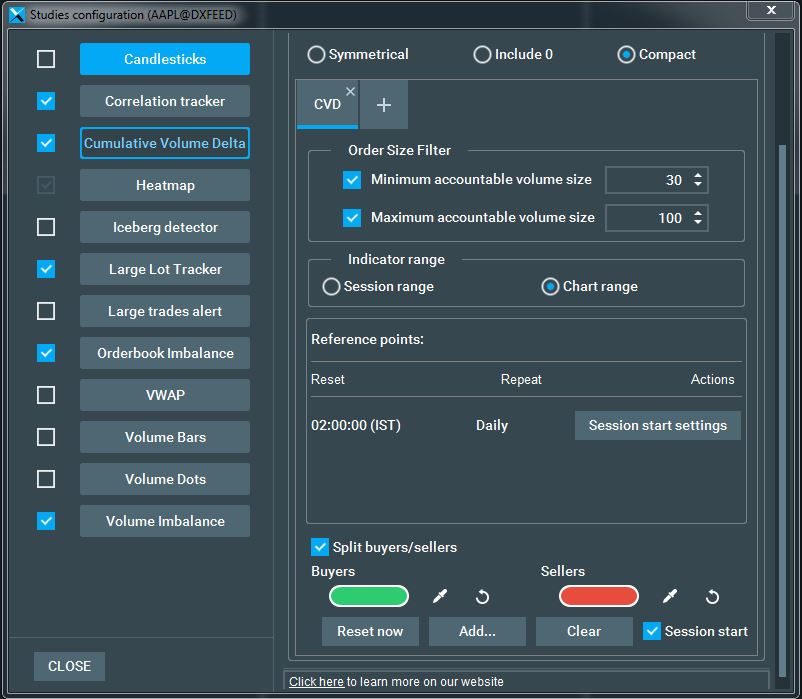
The + button adds another CVD line to the same symbol, each with its own range and reset points. That’s what makes the three-at-once setup possible. Indicator range picks the current chart range or the whole session. Reference points set when it restarts from zero, and Reset Now does it by hand.
You can filter by trade size (minimum and maximum), split buyers and sellers into separate lines, and keep zero centred or let the scale fit the range.
How I read cumulative volume delta on multiple timeframes
Price up, CVD up: the move is being paid for. Price up, CVD flat or down: either someone is lifting price without much aggression behind it, or a seller is absorbing everything thrown at them. At my level, that second picture is the one I want to see before a fade.
Fast and slow agreeing at my level is a green light. Fast and slow disagreeing is a yellow, and I treat yellows like a cautious driver, not a taxi driver.
Two days from the journal: The Model Trade and the One That Got Away With It, where Bookmap, time and sales and cumulative delta all pointed down on the first trade, and Six Minutes at Three O’Clock, where CVD and TickStrike were the confirmation for the day’s trades.
Settings worth knowing
- Add CVD indication (+): several CVD lines per symbol.
- Indicator range: current chart range or the whole session.
- Reference points: reset times and how often they repeat.
- Minimum and maximum accountable volume: count only trades in a size band.
- Split buyers/sellers: two lines instead of one net line.
Bookmap’s own CVD guide has the rest, with pictures.
My screen and settings
Screenshot of my own layout and the settings I run are on the way; until then, Bookmap’s picture above is the honest version.
Questions people ask
Is Bookmap CVD free?
Yes. Bookmap’s guide says CVD is free for all users, and it’s on every tier, including Digital.
Why does my CVD disagree with another platform’s?
Different start points. CVD is cumulative from its reset, so a session CVD and a chart-range CVD on the same chart can point different ways. That isn’t a bug; it’s the reason to run more than one.
Can I leave out small trades?
Yes. Set a minimum (and maximum) accountable volume size and only trades in that band count.
Next: Point of Control · Back to the Bookmap Library · Which Bookmap plan?
Offer and prices as above, checked 7 November 2026. All plans and prices
Disclosure. VWAP.biz is an independent site written by Scott West, a paying member of Drysdale Trading Group™. The VWAP Wave System™ is Chris Drysdale’s work. He doesn’t own or run this site, but he has reviewed and endorsed it. Links to his book, toolkit, and community are affiliate links: if you buy through them I may earn a commission at no extra cost to you. As an Amazon Associate I earn from qualifying purchases. Nothing here is financial advice, and trading futures carries a risk of loss. Full disclosure · Risk disclaimer