Bookmap Stops and Icebergs (SI On-Chart) is an add-on that detects CME iceberg orders and executed stop orders and marks them on the heatmap: when an iceberg was detected, traded, fully executed or cancelled, and where a chain of stops ran. It needs Market-by-Order data and is part of Bookmap’s MBO Bundle.
An iceberg sitting on my level is the best confirmation on the screen. Stops being run through it is the warning.
Which plan: Global Premium (MBO Bundle), or $89 a month on the Bookmap Marketplace. It needs real-time CME MBO data from BookmapData or Rithmic, and it doesn’t work on Nasdaq stocks data.
Stops and Icebergs is in Global Premium or $89 a month on the Marketplace, with MBO data. If you want the heatmap first, the Global Plus offer ($147 for the first quarter) is the cheaper start. Prices checked 7 November 2026. Try Bookmap free first (the free tier is a look at the software, not live futures).
Affiliate link. Bookmap pays me a commission if you subscribe; it costs you nothing extra, and I was paying full price for years before the link existed.
What do the Stops and Icebergs icons mean?
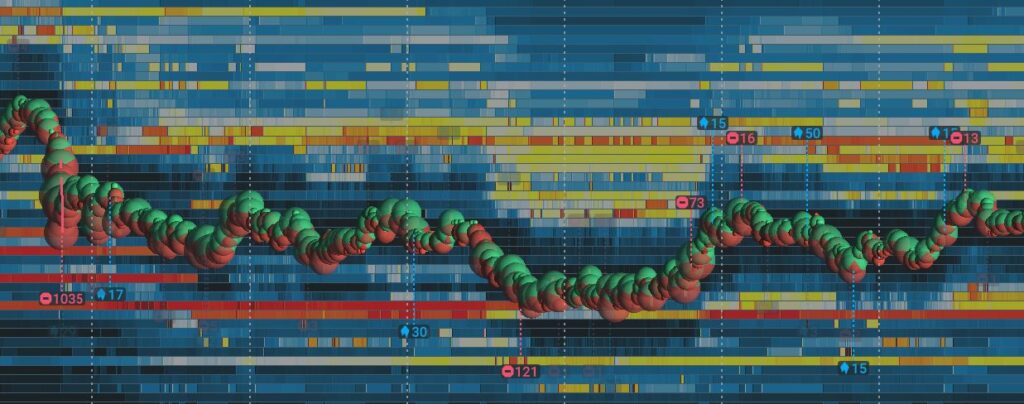
Icebergs are big limit orders split into small visible pieces. The add-on labels each event with a letter and the volume: D for detected, T for a trade against it, E for fully executed, C for cancelled. Up icons are sell icebergs, down icons are buy icebergs. A thick horizontal line marks the price where the iceberg was live.
Stops show as a chain: a bold vertical line over the price range of the stop run, with the total volume on an icon. Up for buy stops, down for sell stops. One chain can hold several stop orders triggered in the same run.
How I read iceberg orders on Bookmap
Blue icons are icebergs, hidden size that keeps refilling at one price. Red stop-sign icons are stop runs. In my own layout they’re number 3: the blue E and C labels and the red stop counts.
The difference between a wall and a trap is often exactly this. The wall has an iceberg behind it. The trap was a few big orders that left when it mattered. Icebergs don’t leave quietly: they get executed or cancelled, and the add-on tells you which.
A stop run into my level isn’t a reason to fade it. It’s a reason to wait one more bar and see who’s left standing.
Settings worth knowing
- Separate stops and icebergs panels: show or hide each type, with its own size threshold.
- Alerts: per type, with a threshold, plus Telegram if you want it on your phone.
- Aggregation lines: group nearby events so a busy level stays readable.
- Versions: SI On-Chart and SI Sub-Chart are the production add-ons; a combined version is in alpha for Bookmap 7.9.
Bookmap’s own Stops and Icebergs guide has the rest, with pictures.
My screen and settings
Screenshot of my own layout and the settings I run are on the way; until then, Bookmap’s picture above is the honest version.
Questions people ask
Why doesn’t Stops and Icebergs show anything on my chart?
It only works on real-time CME MBO data from Rithmic or BookmapData, in non-aggregated mode. Delayed data or Nasdaq stocks data won’t light it up.
Is there a cheaper way to see icebergs?
Bookmap’s Strength Level indicator estimates hidden size from Global Plus (replay only on Global). It’s an estimate. Stops and Icebergs detects CME’s native icebergs from MBO data.
Which plan includes Stops and Icebergs?
Global Premium, through the MBO Bundle, or $89 a month on the Marketplace. The whole MBO Bundle is $134 a month on its own.
Next: Sweeps Indicator · Back to the Bookmap Library · Which Bookmap plan?
Offer and prices as above, checked 7 November 2026. Try Bookmap free first
Disclosure. VWAP.biz is an independent site written by Scott West, a paying member of Drysdale Trading Group™. The VWAP Wave System™ is Chris Drysdale’s work. He doesn’t own or run this site, but he has reviewed and endorsed it. Links to his book, toolkit, and community are affiliate links: if you buy through them I may earn a commission at no extra cost to you. As an Amazon Associate I earn from qualifying purchases. Nothing here is financial advice, and trading futures carries a risk of loss. Full disclosure · Risk disclaimer