
The VWAP Wave System · Supplementary lesson
For most of twenty-five years I read candles the way the books taught: hammers, dojis, engulfing this and shooting that. It was a vocabulary, not an edge. What finally helped was throwing the names out and keeping one idea. Every candle is a vote. The body is what the market agreed on in those five minutes. The wick is what it argued about and lost.
What a wick actually is
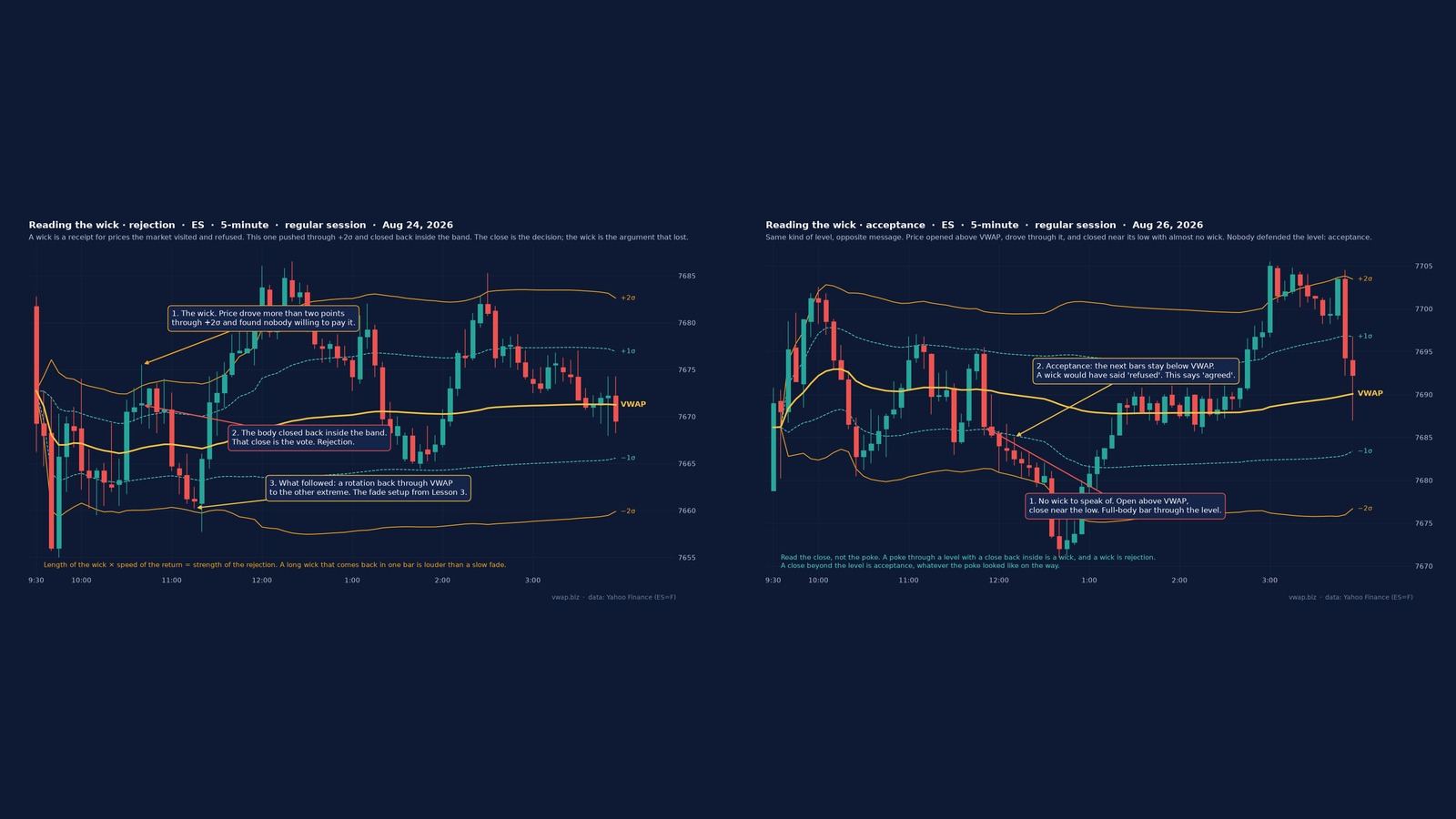
A wick is a receipt for prices the market visited and refused. Price went there, somebody paid it, and within the same bar the rest of the market said no and pulled it back. The longer the wick and the faster the return, the louder the refusal. On a five-minute ES chart, a four-point wick that comes straight back inside a level is a whole crowd changing its mind in under five minutes, and that’s information.

The body is the decision
The opposite bar tells the opposite story. When price drives through a level and closes near the far end with no wick to speak of, nobody defended the level. The market didn’t argue, it agreed. That’s acceptance, and it’s the single most common thing new traders misread, because they see a level get touched and assume a reaction is coming. The bar already told them it wasn’t.

Where wicks matter in this system
A wick only means something at a price the system already cares about. VWAP. The deviation bands. The Initial Balance high and low. Yesterday’s value area. A wick in the middle of nowhere is noise, and I treat it as noise. At a level, the read is simple:
- Wick through VWAP, close back on the trend side. The level held. That’s the confirmation I want on a VWAP Bounce.
- Wick through a ±2σ band, close back inside. The extreme was refused. That’s the confirmation for a fade on a balanced day.
- Full-body close through the level. Acceptance. The fade is dead. On a discovery day that’s continuation; on a balanced day it means the range just moved, and I wait for the next level, not the next candle.
- Wick through the level, close on the wrong side. Nothing. It’s neither a rejection nor a clean acceptance. I read the next bar instead of guessing about this one.
Three things I stopped looking at
- Pattern names. A hammer at VWAP on a discovery day and a hammer in the middle of a range are not the same trade, and the name pretends they are.
- Wicks on the one-minute chart. Every one-minute bar has a wick. Below five minutes there isn’t enough volume in a bar for a refusal to mean anything.
- Wicks in the first bar of the session and around scheduled news. The open and the 8:30 numbers produce wicks that are about liquidity, not opinion. Financial Juice tells me when to sit on my hands.
How I read a bar in three seconds
- Where did it close relative to the level? Same side as before, or through it?
- How far did it poke? A tick is nothing. Two points on ES is a real visit.
- How fast did it come back? Inside the same bar, or did it take three bars to crawl back?
Then the only question that matters: is there a setup here or not? A wick at a level with a close back on the right side can complete a setup. It can never create one. If the condition wasn’t named before the bar printed, the wick doesn’t change that.
The wick is the argument. The close is the vote. My resting order often gets filled during the argument; the vote decides whether I stay.
Why my order is usually resting at the level before the wick arrives, and what I call the wick that fills it, is its own lesson: Sniper tactics: resting orders, wicks, and the Madonna.
Ready for the system itself, not just my lessons on it?
I explain the VWAP Wave System from a student’s chair. Chris Drysdale teaches it. Start with his free Core Setup Guide, read the book, or take seven days inside Drysdale Trading Group and watch it traded live.
Disclosure. VWAP.biz is an independent site written by Scott West, a paying member of Drysdale Trading Group. The VWAP Wave System™ is Chris Drysdale’s work, and this site is not affiliated with or endorsed by him. Links to his book, toolkit, and community are affiliate links: if you buy through them I may earn a commission at no extra cost to you. Nothing here is financial advice, and trading futures carries a risk of loss. Full disclosure · Risk disclaimer