
The VWAP Wave System · Supplementary lesson
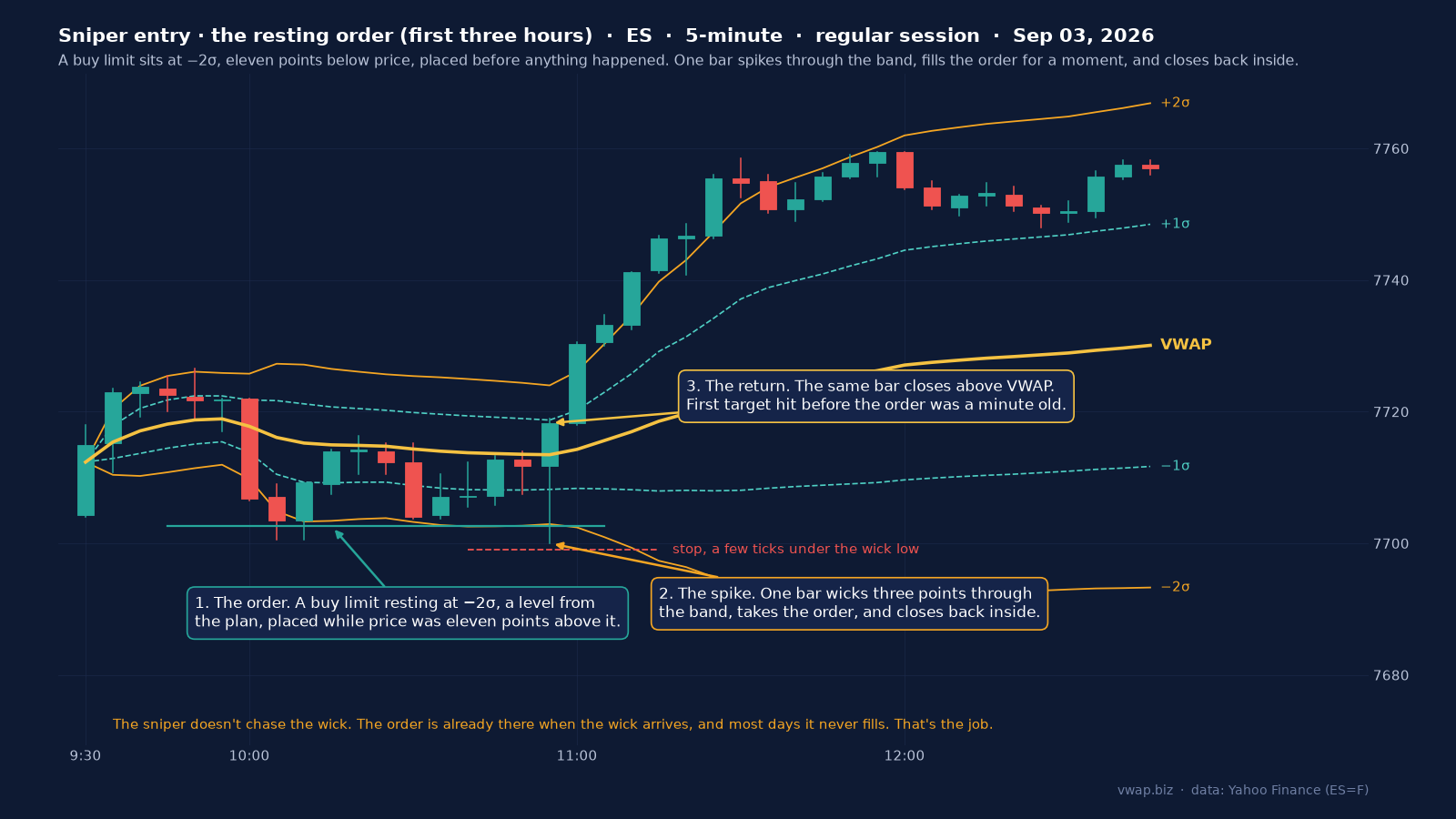
There’s a line in my trading plan that reads, in full, “trade like a sniper.” A sniper doesn’t chase anything. He picks the spot, sets up long before the target arrives, and spends most of the day not shooting. In practice that means one thing on my screen: a buy or sell limit order resting at a predefined level, well away from where price is now. Most days it never fills. Then a spike comes, the wick reaches out for a moment, takes my order, and returns to where it was. I call that wick a Madonna, and it’s the cleanest profit in this system.
What a Madonna looks like
This is one from my own chart. One-minute bars on ES, the evening session, a level I’d marked well before price got anywhere near it. The wick spiked up to it, touched for a moment, and came straight back. A sell limit resting there was filled at the top of the spike, and the short was in profit before the bar closed. Nobody can click fast enough to catch that. The only way to be in it is to be there first.

The rifle is loaded before the wick
None of this works if the level is chosen in the moment. The levels come from the plan: VWAP, the deviation bands, the Initial Balance high and low, yesterday’s value area, the weekly high and low. Each one is graded before the order goes in, A, B, or C, from how many independent reasons agree at that price. An order only rests at an A. A C-grade level gets watched, not traded, because a resting order at a weak level is just a donation to whoever runs it.
The sequence
- Mark the levels before the session. From the plan, not from the last five minutes.
- Place the limit at the level, with the stop and target attached. The order sits well away from price, sometimes ten or fifteen points. It’s a bracket: if it fills, the protection is already there.
- Wait. Hands off. Most resting orders never fill. That’s not a failed trade; it’s the job. Cancelling the order because price is getting close and it “looks like it’s going to break” is the mistake, not the patience.
- The confirmation tools get a veto. If Bookmap shows the size at my level being pulled, or buy runs eating through it, or Market Pulse flags an imbalance against me, I pull the order. If TickStrike goes quiet into the level, I leave it. They can cancel a shot. They never fire one.
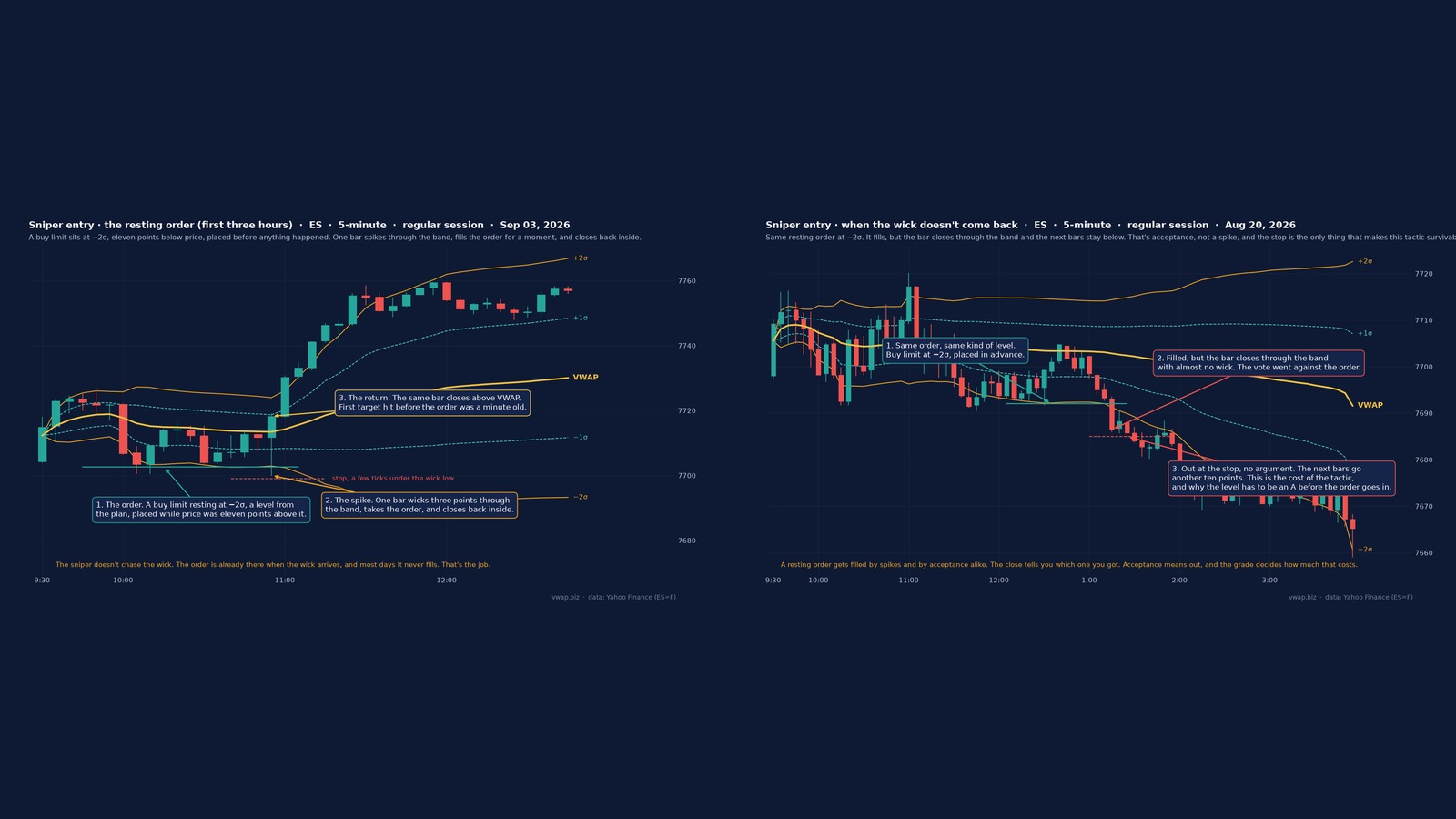
- The spike takes the order. The Madonna. The wick reaches out, fills me, and starts back.
- The close decides what I’ve got. If the bar closes back on my side of the level, the trade is on and the first target is the return toward value, usually VWAP. If it closes through the level, that’s acceptance, not a spike, and I’m out at the stop without an argument.
- Manage the return. Scale out at the first target. The runner stays while the structure holds. The stop never moves the wrong way.
- One shot. If it stops out, I don’t re-place at the same level unless the structure rebuilds. The second attempt at a level is where my old journal bled.
When the wick doesn’t come back
This is the chart that pays for the tactic. Same resting order at the same kind of level. It fills, and the bar keeps going. No wick, a close through the band, and the next bars stay below. That isn’t a spike, it’s acceptance, and it’s why the stop is part of the order and not a decision made afterwards. The stop is the whole reason the good fills are worth taking.

Why it works
Spikes are liquidity events. A stop cluster gets run, a headline hits, someone’s algorithm gets a fill it didn’t want, and for a few seconds price goes somewhere nobody actually wants to trade. The trader chasing that move pays the worst price of the day. The resting order gets the price nobody wanted to pay, and gets paid for being there when the crowd changes its mind. Reading why the wick comes back is its own lesson; the sniper’s job is simply to be at the level before it does.
Sizing the shot
Size follows the grade from Lesson 5, never the excitement of the level. An A gets full size. A B gets less or nothing. A C never gets a resting order at all, because a resting order is a promise to buy whatever the market throws at that price, and I only make that promise where three reasons agree. When I graded my old trades twice, the losers weren’t bad levels. They were resting orders at levels I hadn’t earned the right to trust. The execution column lesson has that story in full.
The level loads the rifle. The order is the trigger, pulled in advance. The close tells me whether I hit anything.
Ready for the system itself, not just my lessons on it?
I explain the VWAP Wave System from a student’s chair. Chris Drysdale teaches it. Start with his free Core Setup Guide, read the book, or take seven days inside Drysdale Trading Group and watch it traded live.
Disclosure. VWAP.biz is an independent site written by Scott West, a paying member of Drysdale Trading Group. The VWAP Wave System™ is Chris Drysdale’s work, and this site is not affiliated with or endorsed by him. Links to his book, toolkit, and community are affiliate links: if you buy through them I may earn a commission at no extra cost to you. Nothing here is financial advice, and trading futures carries a risk of loss. Full disclosure · Risk disclaimer