
Lesson 4 of 5 · The VWAP Wave System, explained
Lessons 1 to 3 gave you a value anchor, a map of how stretched price is, and four setups. Here’s the uncomfortable truth I learned the expensive way, over more sessions than I’d like to count: knowing the four setups is worth almost nothing. Every one of them looks perfect somewhere on every chart, every day. What separates a system trader from a setup collector is the question you ask before you look for a setup: what kind of day is this?
Balance or discovery: the master switch
Auction market theory says the market is always doing one of two things. Either it has found a price where buyers and sellers agree and is rotating around it, which is balance, or it has left that agreement behind and is searching for a new one, which is price discovery. Everything in the VWAP Wave System hangs off that one distinction, and it’s the first thing Chris made me say out loud in class.
- In balance, price crosses VWAP repeatedly, the VWAP slope is flat, today’s value overlaps yesterday’s, and pushes to the outer bands get rejected. Two setups are alive: Fade Value Area Extremes and Return to Value.
- In discovery, price stays on one side of VWAP, the VWAP slopes, the bands expand, and pullbacks hold. Two different setups are alive: Price Discovery Continuation and the VWAP Bounce.
Run the wrong pair and you’ll be fading a freight train or buying pullbacks in chop. Both feel like the system failing. Neither is. It’s the operator failing to classify the session, and I was that operator for a long time.
The single most useful habit I took from the Inner Circle: name the condition out loud before you name a setup. “Balanced, flat VWAP, overlapping value.” Only then: “so the fade is live.” If you can’t say the first sentence, you don’t get to say the second. My small group does this on voice every morning, and it’s uncomfortable exactly as often as it’s useful.
The clock: the first hour tells you first
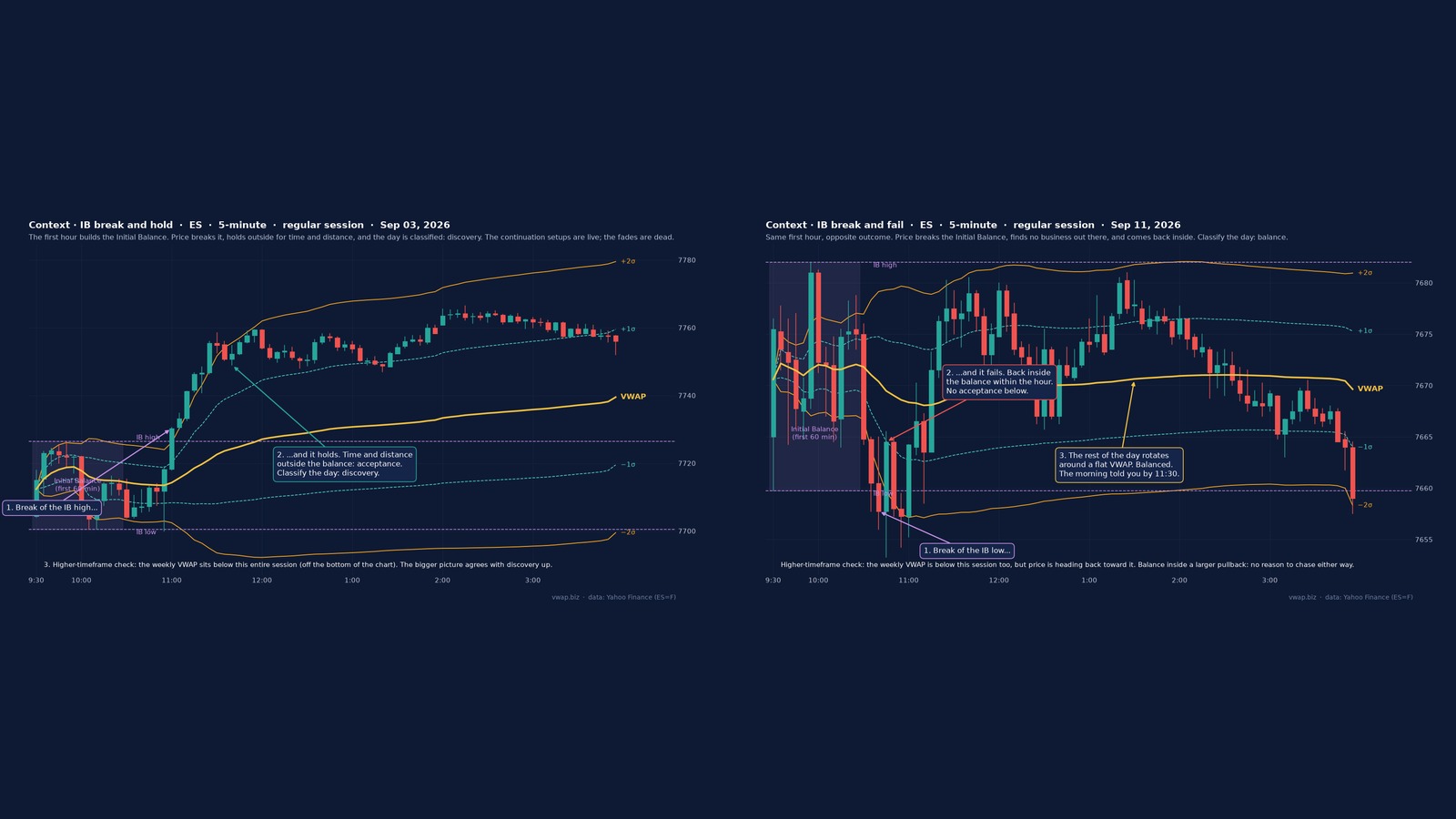
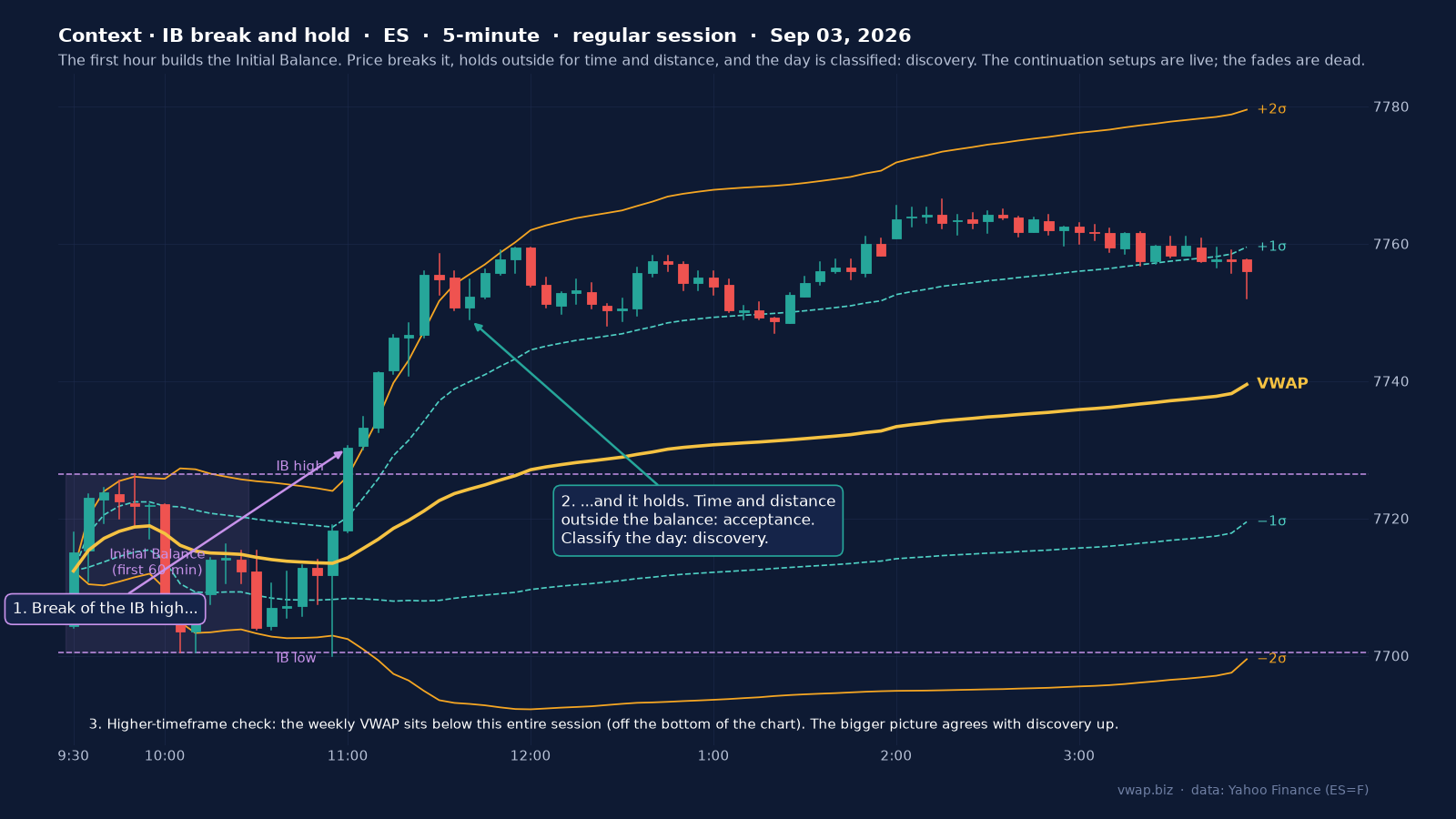
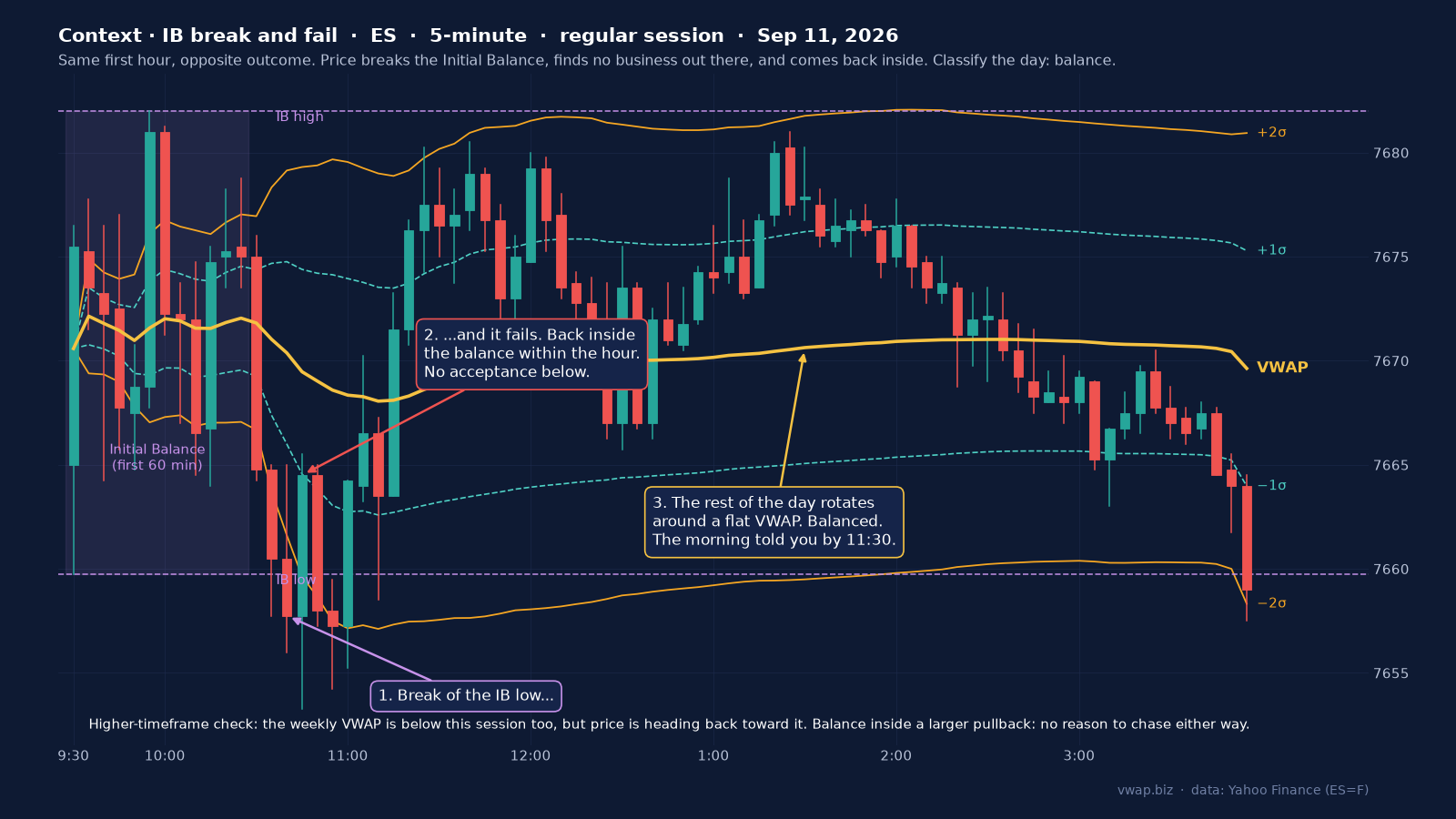
Context has a time dimension. The first sixty minutes build the Initial Balance, the range that defines the early auction. What price does with that range, whether it breaks and holds, breaks and fails, or never leaves, is the earliest reliable evidence of which condition you’re in. Here are two mornings from the same fortnight.
Lunch is dead for a reason. The last hour has its own personality. I keep a Pine script that draws the Initial Balance and its extensions, and I don’t take a setup until the IB has told me something. Day of the week matters too, more than I expected: when I backtested my own session data, some days were consistently clean and one-directional and others were whipsaw factories. That’s my research, not Chris’s teaching, but it lines up with what the system says. Context first, and the clock is context.
Acceptance and rejection: how you know the market means it
The bands tell you where price is stretched. They don’t tell you whether the market accepts that price. Acceptance is time and distance: price moves outside value and stays, building volume at the new level. Rejection is a visit: price pokes through, finds no business, and comes back inside with a wick and no follow-through. Look at the two charts again. Same break of a first-hour range. One was accepted, one was rejected, and the difference is behaviour, not location.
This is where band traders blow up, and where I blew up. They see the second band and short it because it’s the second band. The system asks a different question: is the market accepting outside value, in which case this is discovery and the fade is dead, or rejecting it, in which case the fade has a reason to exist?
Higher-timeframe context
A perfect intraday fade into a daily-chart level everyone is watching is a different trade from the same fade into empty space. The system layers higher-timeframe VWAPs, prior-session value, and composite volume profile on top of the day’s map so you know whether your intraday setup has company. When a setup lines up with a level that matters on the daily, I grade it higher. When it doesn’t, I size it smaller or skip it. That’s Lesson 5.
What this looks like in a session
- Before the open, 5:00 in the morning for me: mark the levels that matter from prior sessions. Write down a bias. Don’t trade it, just write it.
- First hour: let the Initial Balance build. Watch which side breaks first and whether it holds.
- Classify: balanced or discovery. Say it out loud. Say what would change your mind.
- Only now: which of the four setups is live in this condition? Wait for it. Grade it. Trade it or pass.
That’s the whole loop. It’s slower than pattern hunting. It’s also the reason my journal stopped showing me the same mistake ten times a week.
What’s next
You have the map, the setups, and the condition that decides between them. The last piece is what turns it from a method into a business: grading every setup before you take it, risk that survives your worst hour, and a process you can repeat on a Tuesday when nothing is working.
Next lesson, Lesson 5: Grading, Risk, and the Process.
Disclosure. VWAP.biz is an independent site written by Scott West, a paying member of Drysdale Trading Group. The VWAP Wave System™ is Chris Drysdale’s work, and this site is not affiliated with or endorsed by him. Links to his book, toolkit, and community are affiliate links: if you buy through them I may earn a commission at no extra cost to you. Nothing here is financial advice, and trading futures carries a risk of loss. Full disclosure · Risk disclaimer
Ready for the system itself, not just my lessons on it?
I explain the VWAP Wave System from a student’s chair. Chris Drysdale teaches it. Start with his free Core Setup Guide, read the book, or take seven days inside Drysdale Trading Group and watch it traded live.