
Lesson 5 of 5 · The VWAP Wave System, explained
I’ve watched a lot of traders learn a system and lose money with it. I was one of them, for years. The system was fine. What was missing was everything around the setup: how to decide whether this instance of a setup deserves your money, how much money, and what to do when it’s wrong. In the VWAP Wave System that wrapper is not an afterthought. It’s most of the work, and it’s most of what the Inner Circle spent three months installing in me.
Grading before entry
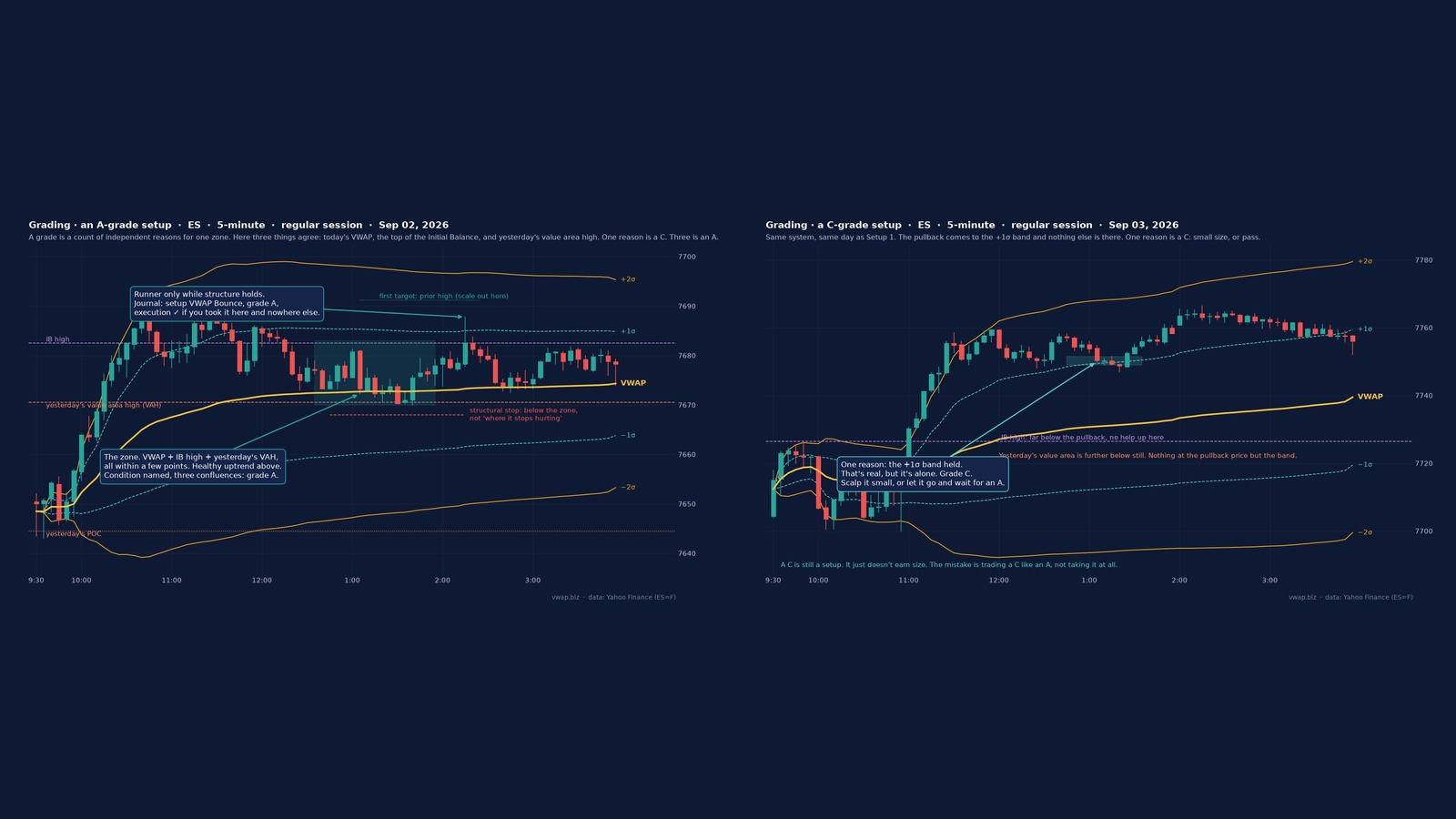
The system asks you to grade every setup before you take it. My version, adapted for my own plan, uses letters. An A setup is one where several independent things point at the same zone: a VWAP band, a volume-profile level, the Initial Balance, price behaviour showing rejection or absorption, a higher-timeframe reason for the level to matter. A B has two of those. A C has the pattern and not much else.
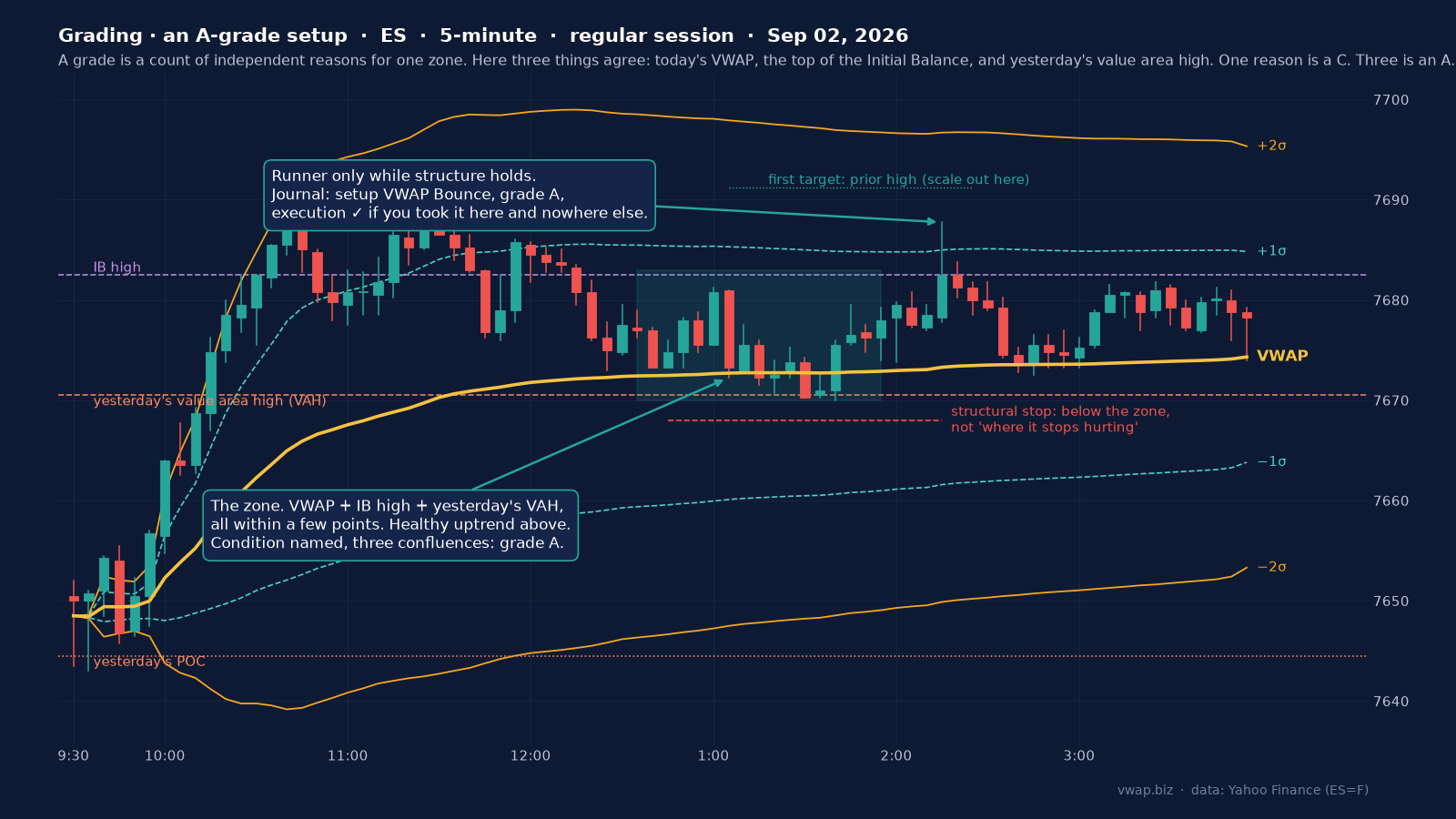
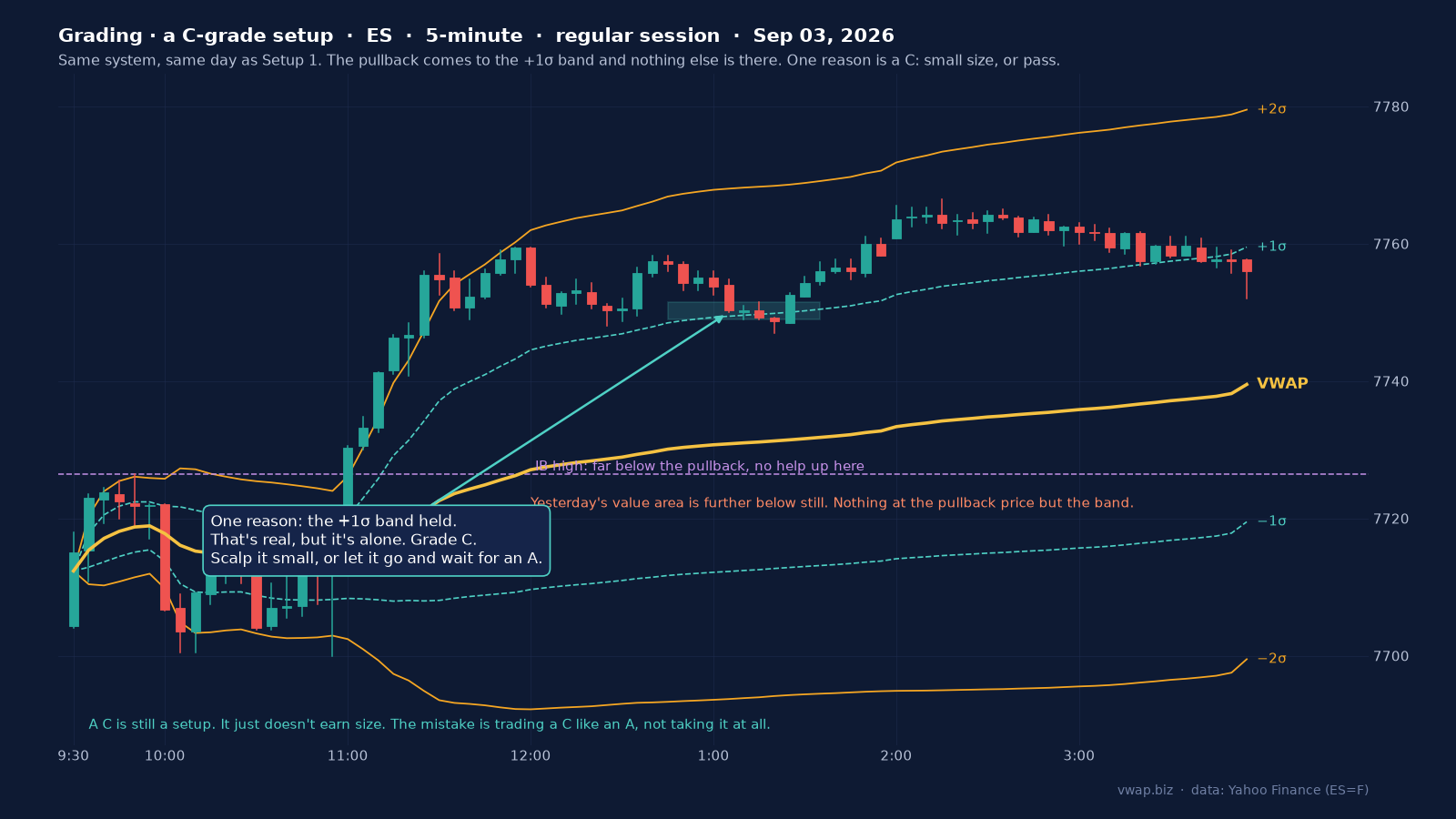
There is no D, and there is no F. Anything below a C isn’t a graded setup at all: it’s an impulse with a chart behind it, and it doesn’t get a letter because it never should have been taken. Naming that distinction changed my trading more than any entry rule. Most of the losers in my old journal were trades I’d talked myself into that never had a setup name.
Rule from my trading plan, the one I committed to in the Inner Circle: trade like a sniper. Size up on A’s. Scalp C’s or skip them. Never take a trade you can’t grade, and if you did, write it down as exactly that.
Risk that survives the worst hour
Every setup has a structural stop: the other side of the candle that tested the level, or the point where the market accepts a price that says you’re wrong. Look at the red dashed line under the zone on the A chart. It’s there because the zone is there, not because that’s how much I could stand to lose. The system is explicit that a stop is a statement about the auction. If the structural stop is too far for your sizing, the answer is smaller size or no trade, never a tighter stop the market didn’t agree to.
Above the trade sits the session. I run a fixed daily loss limit, and when it’s hit the platform closes. Not “one more to get it back.” Closed. Simulator drills and chart mark-ups are allowed; live orders are not. That protocol exists because I’m a human being with a nervous system, and the hour after a max loss is the most expensive hour in trading. Ask anyone in my group.
Scaling and exits
Because the setups are built around zones rather than prices, entries can scale: two or three pieces around the zone instead of one all-in fill. Exits scale too. First partials come at the obvious magnets, VWAP, the point of control, prior extremes, the dotted line on the A chart. Runners are held only if structure supports continuation. The rule I repeat to myself: the first target is where the market has already shown interest, not where I’d like it to go.
The process is the product
Every trade in my journal gets three fields: the setup name, the setup grade, and an execution grade, which is a simple tick or cross for whether I followed the plan. The execution column is the one that matters. A B setup executed cleanly that loses is a good trade. An A setup I chased late and got stopped on is a bad trade, whatever the P&L said. Grading the process instead of the outcome is the only way I’ve found to improve at something with this much randomness in it.
Weekly, the journal gets summarised and reviewed. In the Inner Circle that’s a homework requirement with a mentor reading it. In my small group it’s five people reading it. Outside both, it should still be a requirement, with you reading it. Daily grades roll up into weekly ones. Over a quarter they tell you the truth about your trading in a way no equity curve can.
Where this leaves you
Five lessons, one system. VWAP as value. Bands as the map. Four setups matched to two conditions. Context deciding which pair is live. Grading, risk, and review turning a method into a repeatable process. That’s the shape of the VWAP Wave System as I understand it, and I’ve tried to give it to you without giving you Chris’s material, because he gives it better and it’s his to give.
If the shape makes sense to you, the next step is the source. His free Core Setup Guide is the four setups in his words. The book is the whole framework. The seven-day trial is the system traded live. And when you’re serious, the Inner Circle is where the wrapper, the grading, the risk, the accountability, gets installed in you by someone who won’t let you skip it.
Disclosure. VWAP.biz is an independent site written by Scott West, a paying member of Drysdale Trading Group. The VWAP Wave System™ is Chris Drysdale’s work, and this site is not affiliated with or endorsed by him. Links to his book, toolkit, and community are affiliate links: if you buy through them I may earn a commission at no extra cost to you. Nothing here is financial advice, and trading futures carries a risk of loss. Full disclosure · Risk disclaimer
Ready for the system itself, not just my lessons on it?
I explain the VWAP Wave System from a student’s chair. Chris Drysdale teaches it. Start with his free Core Setup Guide, read the book, or take seven days inside Drysdale Trading Group and watch it traded live.