
Lesson 1 of 5 · The VWAP Wave System, explained
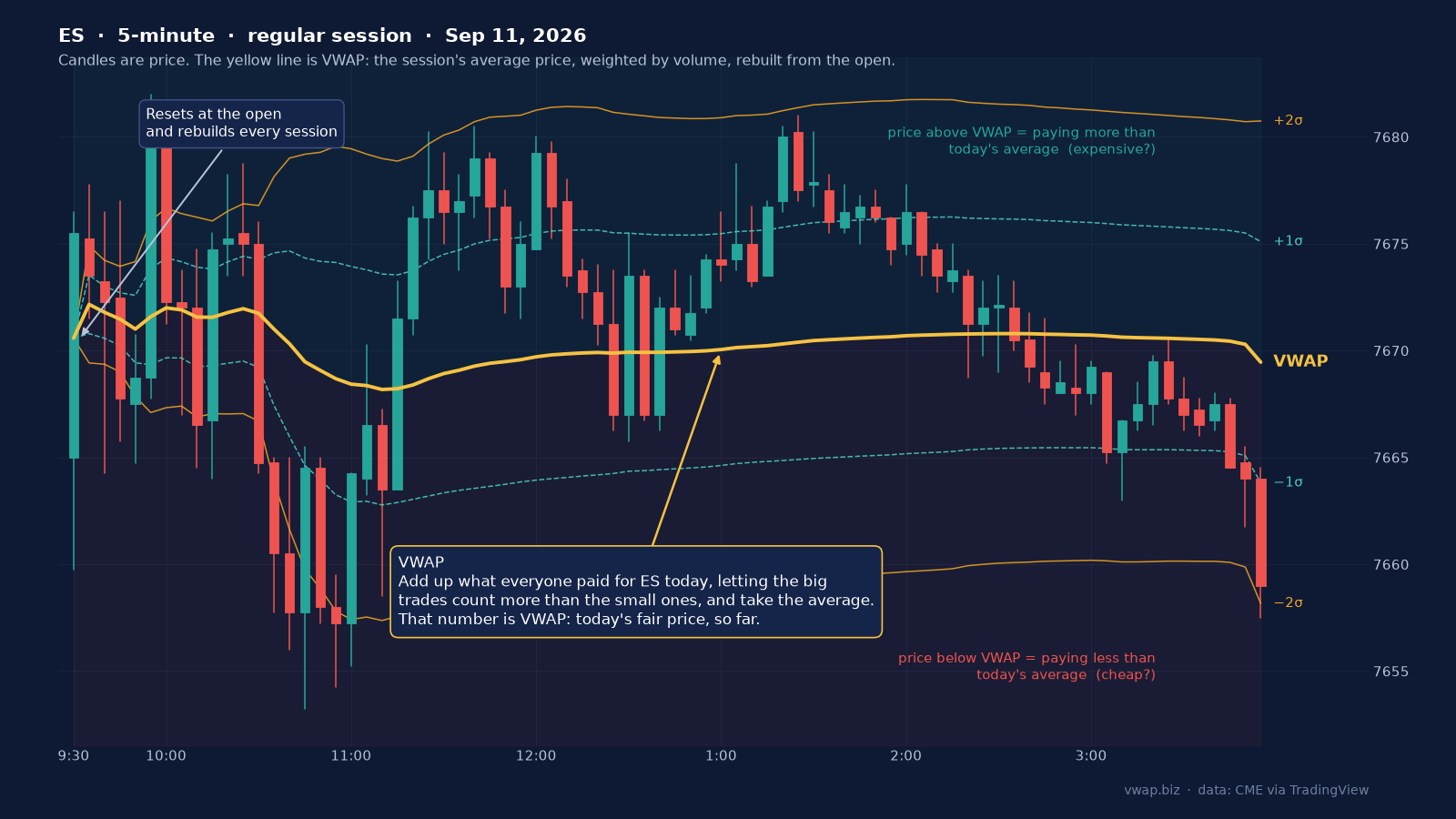
For most of my twenty-five years in the markets my charts looked like a cockpit. A dozen indicators, three timeframes, and a new favourite every quarter. I could explain any trade after the fact and almost none of them before. What finally changed that wasn’t a better indicator. It was throwing most of them away and anchoring to one line, the way the professionals I’d been trying to imitate had been doing all along. That line is VWAP, and it’s the yellow one on the chart above.
What VWAP actually is
VWAP stands for Volume-Weighted Average Price, and the name says it plainly. Add up what everyone paid for the ES today, let the big trades count for more than the small ones, and take the average. Every morning at the open it resets to zero and starts rebuilding from the first trade. By lunchtime it’s the honest answer to a simple question: what has today’s business actually been done at?
I think of it as today’s fair price so far. Institutions think of it the same way, which is why it matters: a desk moving real size is judged on whether it filled better or worse than VWAP, algorithms reference it all day, and because so much money is anchored to that one number, price behaves differently around it. It isn’t magic. It’s where the crowd is.
The definition, properly. VWAP = the sum of price times volume, divided by the sum of volume, from the VWAP’s anchor point. In words: the average price today’s business was actually done at. On the charts in this course the anchor is the 9:30 open, so the line resets every session. Move the anchor somewhere else, a swing high, a news candle, and you have an anchored VWAP, which gets its own lesson later.
Why I stopped guessing what was expensive
Here’s the mistake that cost me the most money over the years, and I see it in every new trader in my group: buying because something looks strong and selling because it looks weak, with no reference for whether the price you’re paying is expensive or cheap for today. Strong compared to what? VWAP gives you the what. Price above the line means you’re paying more than today’s average. Price below it means you’re paying less. That doesn’t tell you what to do yet, but it tells you where you are, and for twenty years I didn’t even know that.
In the VWAP Wave System, the framework Chris Drysdale lays out in VWAP Wave System: Day Trade the Futures Market with Structure, Context, and a Discretionary Edge, VWAP is the value anchor. Price above it is potentially above value, unless a real trend is holding it there. Price below it is potentially below value. That word potentially is doing a lot of work, and the next paragraph is why.
The beginner mistake, which I made for years
We never trade just the line. You don’t short because price is above VWAP and you don’t buy because it’s below. That’s how I got run over on trend days for longer than I’d like to admit, and it’s the nuance Chris hammers home from the first page.
VWAP is a reference point, not a signal. The first question I ask every session, at 5:30 in the morning in Alaska with the coffee still too hot to drink, is: where are we relative to value? Not “is this a buy.” Everything else in the system, the bands, the four setups, the grading, builds on that one question. Get it right and the chart gets quiet. Skip it and you’re back to the cockpit.
What’s next
A single line tells you where value is. It can’t tell you when a move is stretched, when price has travelled too far, too fast, to be sensible. For that the system adds deviation bands, and that’s where the Wave in VWAP Wave System comes from.
Next lesson, Lesson 2: The Wave, how deviation bands turn one line into a map.
Want the full framework instead of piecing it together lesson by lesson? The complete methodology is laid out step by step in Chris’s book, VWAP Wave System. It’s the system I trade every session.
Disclosure. VWAP.biz is an independent site written by Scott West, a paying member of Drysdale Trading Group. The VWAP Wave System™ is Chris Drysdale’s work, and this site is not affiliated with or endorsed by him. Links to his book, toolkit, and community are affiliate links: if you buy through them I may earn a commission at no extra cost to you. Nothing here is financial advice, and trading futures carries a risk of loss. Full disclosure · Risk disclaimer
Ready for the system itself, not just my lessons on it?
I explain the VWAP Wave System from a student’s chair. Chris Drysdale teaches it. Start with his free Core Setup Guide, read the book, or take seven days inside Drysdale Trading Group and watch it traded live.