

People ask me how I actually trade. Not the theory, the day. This is it, start to finish: what’s on my screens, when I sit down, what I’m allowed to do, and what happens after the close. It’s the plan I committed to, written the way I live it.
The short version. The tools run whenever the market is open. My orders wait at levels I chose before the session. I know a setup’s grade when I take it, and that’s where the decisions are. The tools can veto a trade, never start one. Three losses and I’m done for the session. After the session, every trade gets graded again in the journal.
The screens are always on
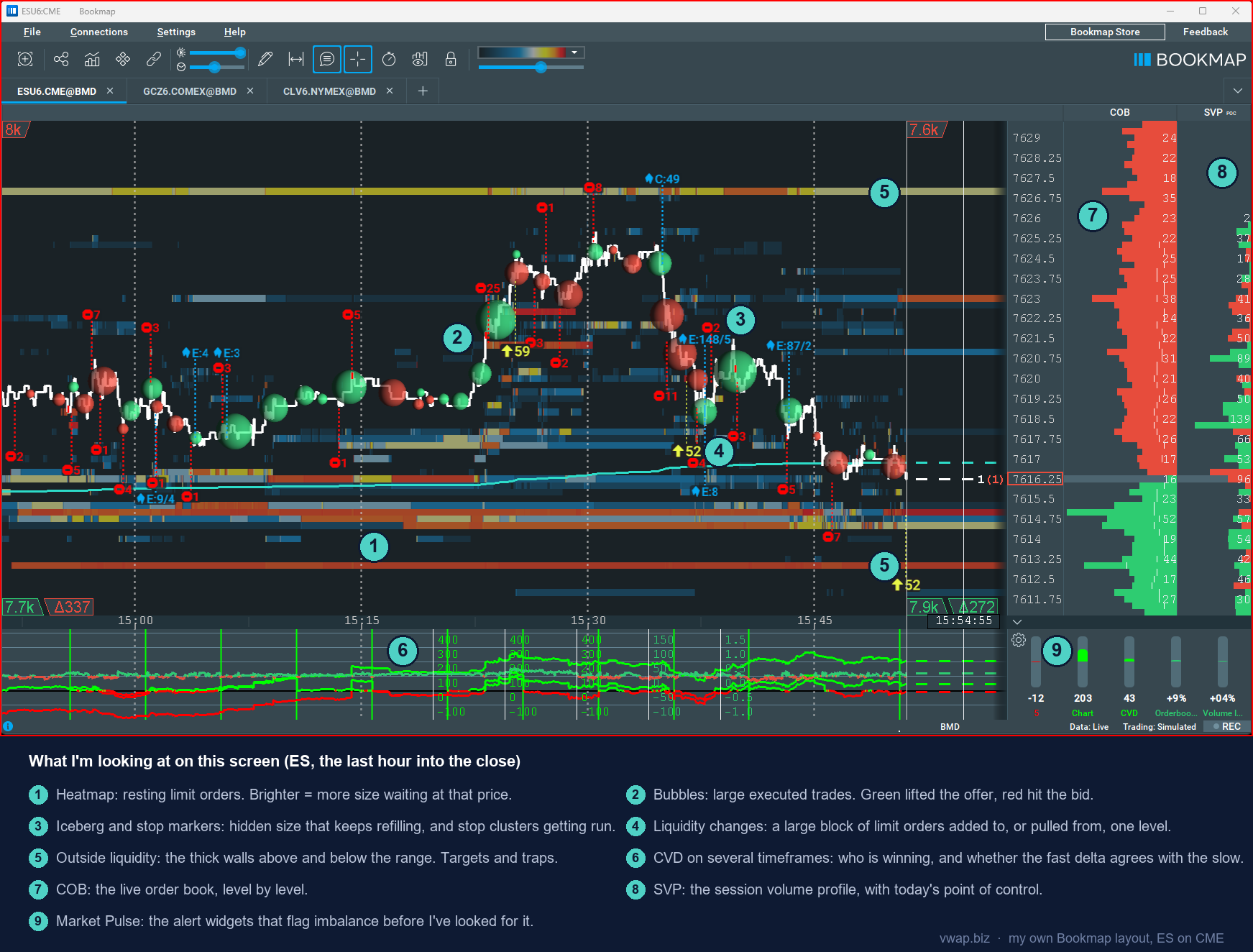
Financial Juice Elite and TickStrike run whenever the market is open, even on days I’m not trading. I don’t trade without them. The headlines and the sound of the tape keep me aware of the market whether I have an order in or not. The 36 news feeds I follow are listed on the Financial Juice page.
On my ES chart, my watchlist never leaves the screen. Whenever the market is open I’m watching the prices and percentage moves of the index futures, the VIX, Bitcoin, gold and silver.
The rest of the desk: TradingView for charting, with Pine indicators I wrote for VWAP sessions and the Initial Balance. Bookmap for the order book. NinjaTrader and Tradovate for execution. I buy my tools on lifetime or yearly plans whenever I can. That’s how I keep more of my profits. Trading tools are expensive, and they need to be managed.
Before every session
I’m not a morning person. The New York open is 5:30 in the morning where I live, in Alaska, and I don’t like getting up early, so I rarely trade it. I’ve focused my learning on the later hours of the day session and the evening Globex session, and that’s where I do my best trading.
Whichever session it is, the prep is the same. I sit down half an hour before I start trading. The first five minutes are silence. Then I read my trading principles, the same page every time, and get to work:
- Mark the overnight levels and the historic ones near the current range: prior points of control, low-volume nodes, VWAPs and value areas.
- Run my AI news scan and note the times on the calendar that matter for the session.
- Set a bias for the session: bullish, bearish or neutral.
I watch before I trade
When the prep is done I don’t trade right away. I watch first: where the whole market is going, what the session has built so far, which setups are starting to form. I call it getting the feel of the market.
What I trade, and what I don’t
Mostly ES and NQ, with gold and crude when they set up, in the later hours of the day session and the evening Globex session. Only the four setups of the VWAP Wave System™, in my order of preference: Price Discovery Continuation, Fade the Value Area Extremes, Return to Value, and the VWAP Bounce.
Chris has a name for one of those fades that’s a running joke in the DTG™ community: the Madonna, when price touches an Initial Balance level for the very first time after it’s set. Touched for the very first time, like the song. It’s a real trade.
Sometimes, when conditions are right, I trade the wick like a sniper. My order rests at a level I chose before the session, well away from price, and most days it never fills. Now and then a spike reaches out, takes the order, and snaps back.
The confirmation tools get a vote. Bookmap, TickStrike and Financial Juice can veto a trade. They never create one. If there’s no setup at one of my levels, nothing on my screens gets me in.
What I stay out of: the lunch hour, the last hour of the day, and the big releases, FOMC, NFP and CPI, unless a clean setup is already there.
The grade, and the decision
I know a setup’s grade when I take it: A, B or C. That’s where the decisions come in, the discretionary part Chris talks about. Should I enter this trade even though it’s only a C?
The harder questions come later. Why did my A+ trade fail? And why did I take a bigger loss than usual on it, just because it was an A+? Our egos don’t like to be wrong.
Risk is decided before the trade
Every account I trade has its own written plan: a maximum loss per trade, a daily loss limit, and a contract cap. A loss in one account never buys more size in another. On a prop account, the firm’s rules are the backstop. Mine are tighter.
I scale out. First partials come off at VWAP, the point of control, or the prior extreme. A runner stays only if the structure supports it.
And I have a three-strikes rule:
- Strike one. I stop for at least five minutes, and until the trade is fully journaled.
- Strike two. I step away for five to ten minutes, reset, and re-read the market before I come back.
- Strike three. I’m out for the session. Out for the session, not the game. Simulator drills and chart markups only.
If I hit my daily loss limit, the platform closes. Same rule: walk away.
The questions traders ask me most about stops, size and daily loss limits, answered live: Ask Groot.
After the close
After the session, every trade gets graded again in my journal (TradeZella): once for the setup, A, B or C, and once for the execution. Did I follow the plan or not? Then the journal gets finished, I review the news, and Claude Code checks my numbers instead of my feelings. After that it’s classes, books and charting practice.
Every session also gets a public write-up in my Trade Journal: the chart, the trades and what I left.
Marking up the chart is one part of my journal. Every trade goes on the chart where it happened: its number, the session, the size, which account, and a note. These two are from one evening Globex session.
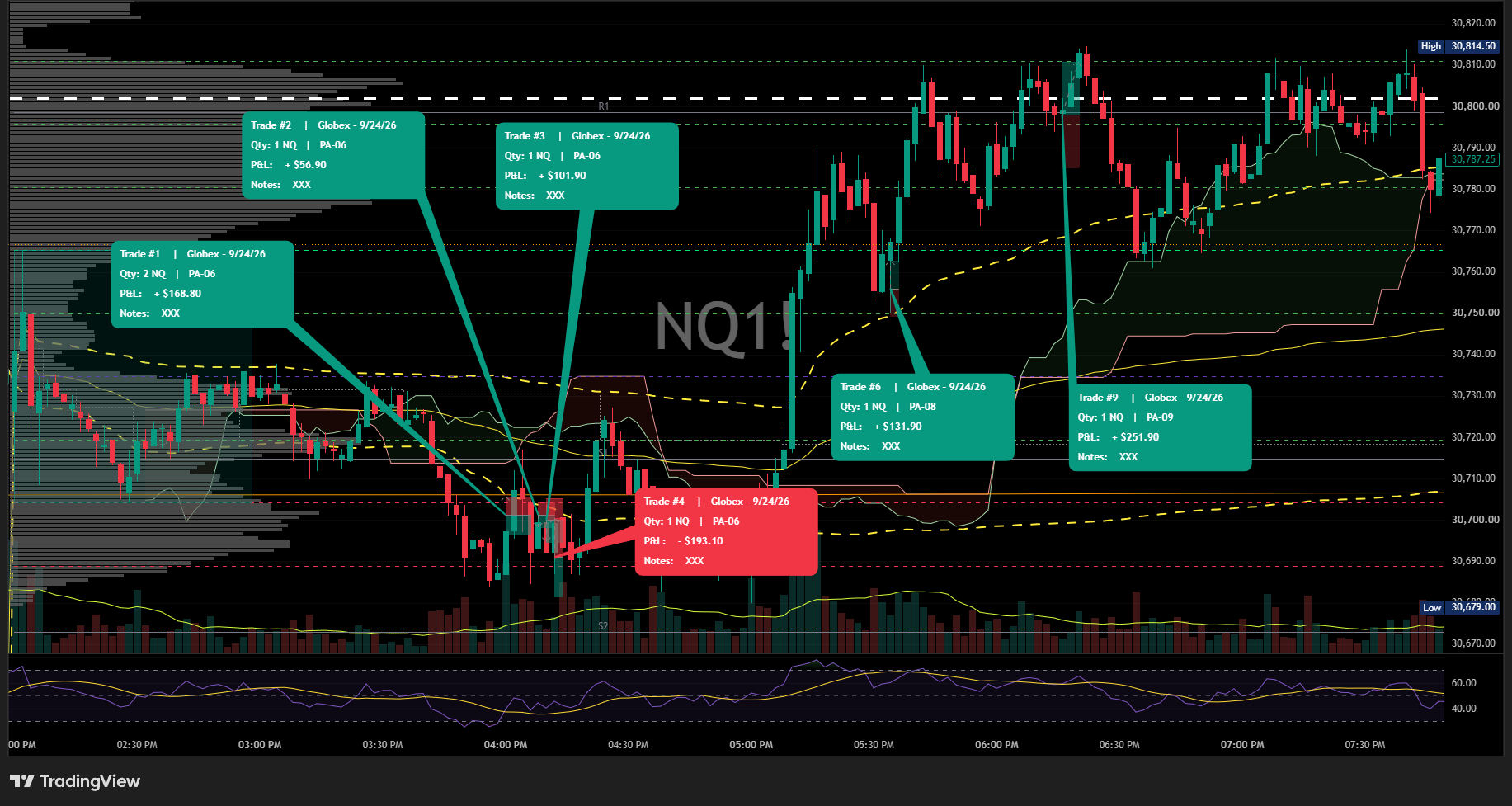
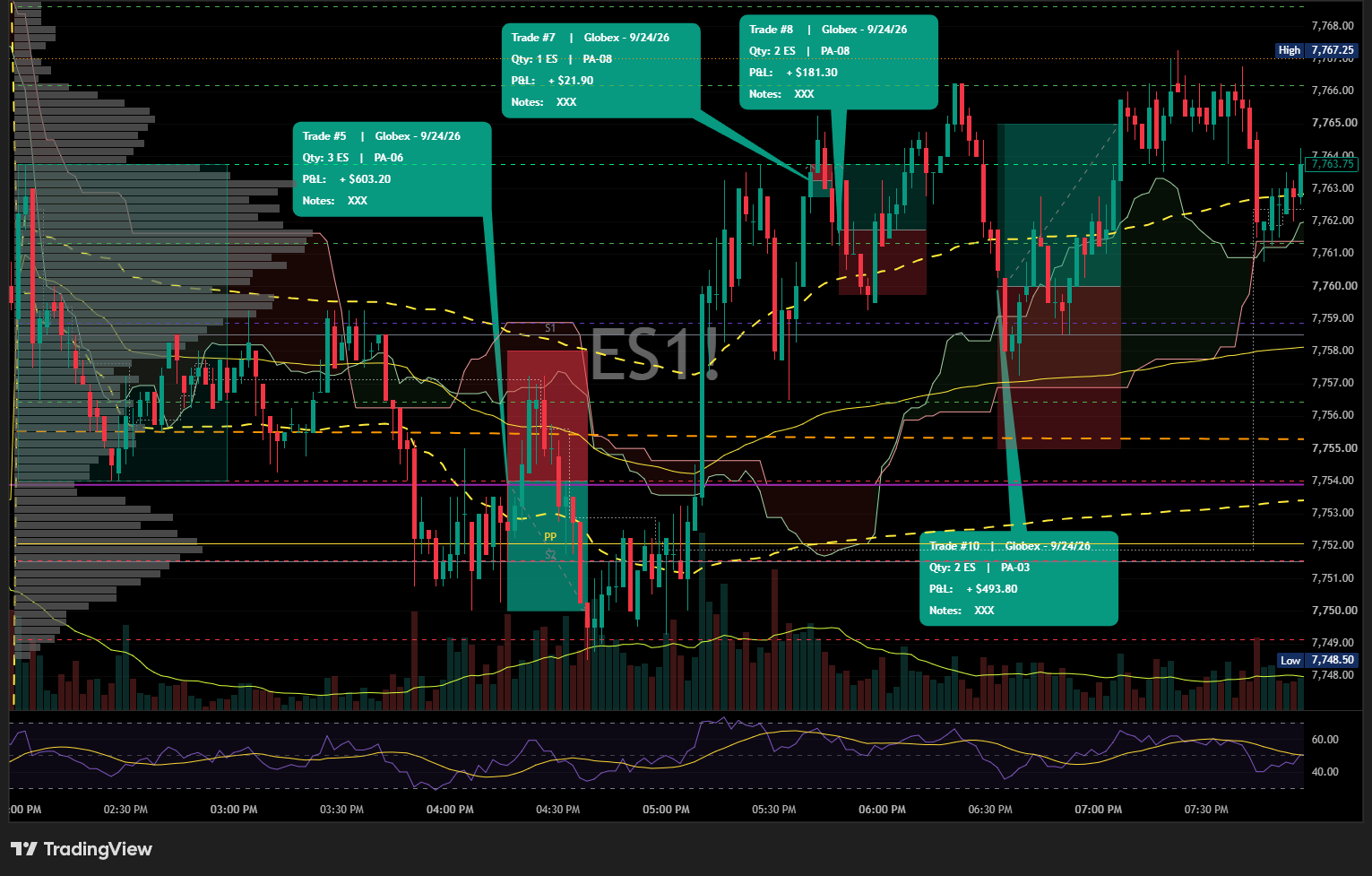
Click a chart to enlarge it. The P&L is real and the loser is in there too. These are prop-firm accounts, which trade in a simulated environment, and one evening’s results aren’t typical or a promise of yours. See the risk disclaimer.
Who I trade with
I’m not alone at the desk. Our small group trades the same playbook on Discord every day. And when I stream, you can watch the whole process live, including the long stretches where the right trade is no trade.
Chris Drysdale also interviewed me about my wheel system, the way I run my funded accounts, and it went out across the whole DTG community.
This is my plan, shared so you can see how one trader runs the system. It isn’t advice, and it shouldn’t be your plan. Yours has to be yours.
Disclosure. VWAP.biz is an independent site written by Scott West, a paying member of Drysdale Trading Group™. The VWAP Wave System™ is Chris Drysdale’s work. He doesn’t own or run this site, but he has reviewed and endorsed it. Links to his book, toolkit, and community are affiliate links: if you buy through them I may earn a commission at no extra cost to you. As an Amazon Associate I earn from qualifying purchases. Nothing here is financial advice, and trading futures carries a risk of loss. Full disclosure · Risk disclaimer
Ready for the system itself, not just my lessons on it?
I explain the VWAP Wave System™ from a student’s chair. Chris Drysdale teaches it. Start with his free Core Setup Guide, read the book, or take seven days inside Drysdale Trading Group™ and watch it traded live. All of it is online and in English, wherever you are.